The Girls Of Riyadh

Have you read this book yet?  I inhaled it in about a day.  There were some facets of the life that it depicts that were totally alien to me – imagine being in college and texting a male being taboo and risqué, or talking on the phone with a man you had not met yet being haraam.  On the other hand, despite cultural differences to courtships, people (ahem, men) behave basically the same all over the world – they say they’ll call you but well, you all know how that story ends.  An “Aunt” to the women of the book basically advises them to follow The Rules (it’s set in the 90s so this makes complete sense, I knew predatory blonde sharks swimming around Manhattan who carried that book around with them then. . . )

This book covers the lives of four female friends in and out of Saudi Arabia, looking for love. It gives really good insight into the process with the parameters of Islam.  And to me, it seems like everything was felt to a higher degree than it would have been in the West, because there was so little interaction prior to setting off in some form of a relationship. Honestly, there was not enough Ben and Jerry’s out there to cure the break up blues in the book.   That being said, I cried, at times, over the way these women were somewhat more discard-able within their society than I would like to think I am in mine.

Two things really intrigued me about the book.  The first was the distinctions drawn as to what was a truly Islamic nation versus what was a Muslim nation (some of the women felt that only Saudi Arabia was a truly Islamic Nation, others felt that the whole Gulf, an area of more fundamental Islam than some other Muslim countries were true Islamic countries.)  The narrative examines the many levels of Saudi society and its almost caste like structure (something I think I’ve seen in Egypt as well), and how much a cognomen can say about a person.   These names indicate far more than the region or religion (as an example, to some, my own last name can indicate specific countries in the British Isles and Catholic or Protestant) we can derive from Western names, but almost a complete socio-economic history of the family.  Yikes.

I read the book while watching the BBC cover what it was calling The Arab Uprising, and including parts of the world formerly known as Persia. And not to sidetrack too much into the false geopolitical constructs that resulted from the Great Game, but there is an extra level of irony that it was the BBC  using these vagaries. The juxtaposition between the BBC’s blanket reference to a part of the world that covers at least two continents (I’d argue three, because Turkey is secular and European, but also may qualify as part of this world culturally) with the detailed inside view of society offered by The Girls of Riyadh made me realize how much of the social nuances in this world are being missed, even by some of the premier news agencys of the West.

The other aspect of the book that struck a particular chord in me was  how many of the footed cultural references referred to Egypt.  While Saudi Arabia may be the Islamic of Islamic countries, it is clear that for most of the Muslim world Egypt was providing the best in arts and culture.  Along with the slogans calling for Mubarack to resign and leave, the protestors during the recent revolution also held signs urging Egypt to “Show The World What Egypt Can Do Again” – referring to a revival after 30 years of cultural decline under Mubarack as well.  Walking around Cairo, you see old movie theaters converted into automotive repair shops, dance halls in decline and various other signs of cultural neglect in a city that was one of the first to bring the world arts and culture.  Hopefully, a new regime can restore its glory.

Bugs and Heart

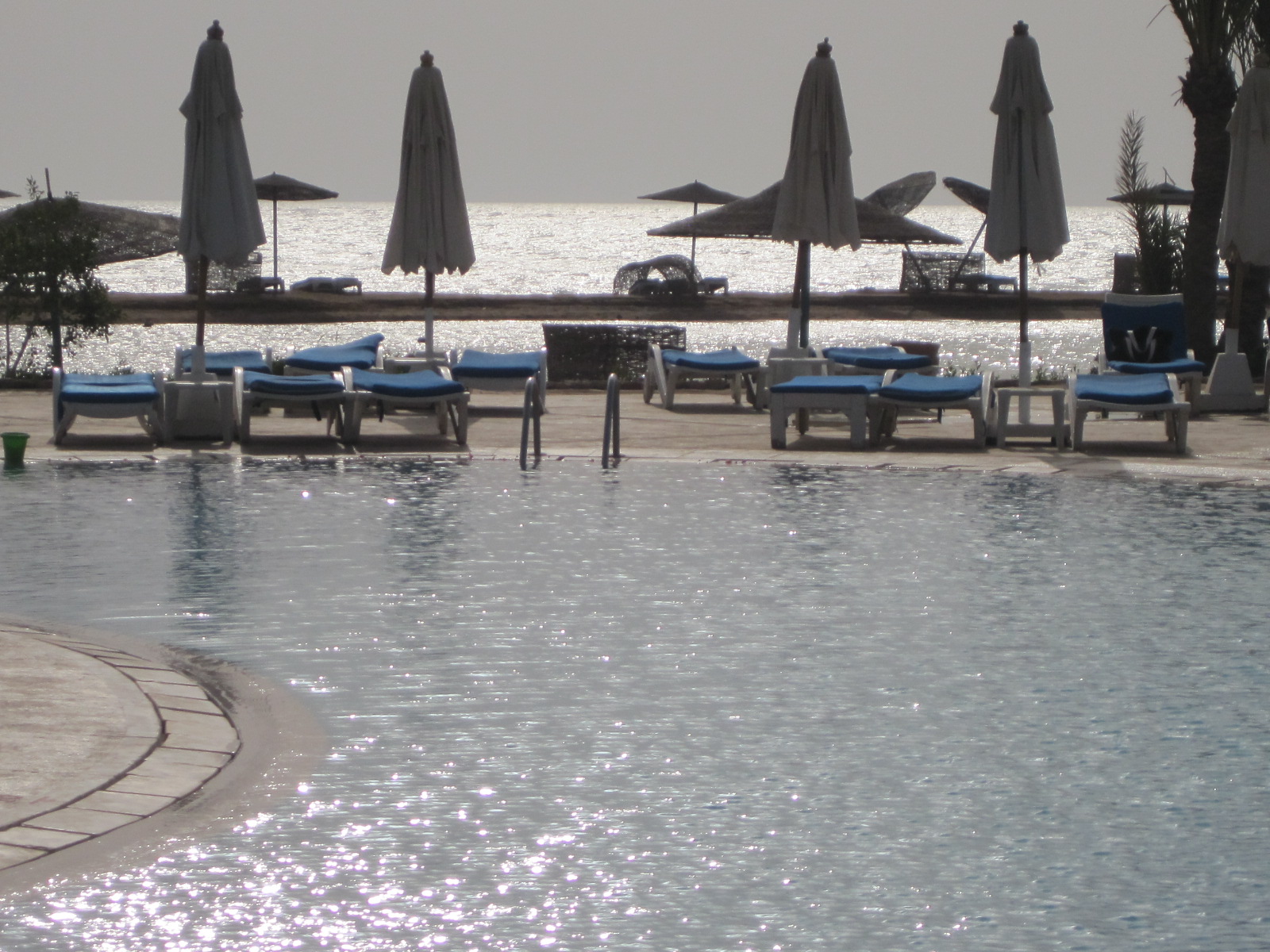
Moon over Movenpick

My second night staying in a room at El Gouna by myself – there was a giant bug in the bathroom.  OK, giant only to my bug-phobic self; take the space between your thumb and the next closest finger – that was the length.  The width was roughly a thumbnail.  It was enough to have me bouncing on my toes in squealish girly girl disgust.  So I call housekeeping.  Somehow, during the call, my asking that someone take care of the bug and spray the bathroom becomes a complaint about the smell of the room.

To the rescue comes Mamoud (sp?) from housekeeping, in rubber boots and the polo and cotton pants of the grounds crew, with incense and Clorox to make the room I’m staying smell cleaner and better.  I explain it’s not the smell, but a giant bug (breaking back into my signature oh god a bug dance – bust a move) that I’d like him to deal with.  He reaches out with his boot, smashes the bug with an audible crunch, matched by my stomach twisting, and then picks it up with his hand.  He then holds it out to me, and says, “It’s just a part of nature, come take a look.”  I creep out from the corner I had danced behind, and do indeed cosy up, kind of sadly, to the carcass to which he says, “You have heart.” And asks if I’m staying by myself.   I say yes, and he says is there anything else I need.  I explain that housekeeping is coming to help me find the modem.  He says, “Bah, I’ll call my friend, he’s the electrician here, and he’ll help.”

The Next Day

Eventually, the IT guy shows up – he’s in khakis, a button down and a tie, higher up on the Movenpick food chain – and he too cannot figure out where the modem is.  He explains that the hotel recently redecorated rooms, and he had to check where it was, and asks if I am staying by myself.  While he is trying to figure it out, my housekeeping friend gets his electrician friend to come over, and he finds the modem slot covered in the wall.  All three wait to make sure I can get online – it’s a party, me and three nice Egyptian men in my hotel room.

As the party ends, and the guests begin to leave, my new friend asks if I want a guard outside the door, he can get someone big and strong to make sure there is no trouble.  Aw, shucks.

Toy Shopping

Bags of Sand for Sale in Maadi

Redundancy much?  Why does a country which is mostly desert need to bag and sell sand?  And why does the age cap out at 8?

We went toy shopping for the birthday party of two 5 year olds – a boy and a girl who are good friends.  Toy shopping in Egypt is its own wild experience.  While toys are basically the same all over, even in this area of relative innocence, the gender divide is extremely evident.  The first toy store we walked into (an educational oriented store supposedly) had walls and aisles of trucks, dragons, knights, castles, hand propelled quarries (um, yeah try explaining what that is to a 5 year old) and building materials, blocks, and legos in ships, castles, dragons, aliens and anything else little boys would like or could possibly imagine.  For girls, you could be princess, nurse, shopping for food, cooking food or practicing to be a secretary or play with fairies  – as long as it was lilac or pink.  It was like a full blown split describing a lot of the domestic gender associations seen in this society aimed at newborns to 8 year olds.  Might as well start them early.

Real Real Housewives of Maadi

Basket seller on a tree lined street in Maadi

Maadi is its own unique place in Cairo, and even Egyptian history.  It’s actually not all Cairo, but also part of the Helwan township. People have inhabited this land since at least 3250 BCE, in the protodynastic period during the Bronze Age. Which makes sense, because its ground is very fertile and it is beautiful. As my friend Matthew put it, you can ”hear the echoes of history here.”  It’s a sprawling area, with old parts that include villas and ruins, and new parts popping up high rises and mc-mansions, Northern Africa style.  (It took me a little while to get used to the references of Egyptian history in modern architecture, I would think –How hooky, they’re trying to be Egyptian, and then remember where I was – This Is Their History.)

Inhabiting Maadi currently is a mix of upper middle and upper class Egyptians, expats and expats married to Egyptians.   The quality of life in Maadi is exceptional  – gardeners, house keepers, cooks are easily (and cheaply) had and a driver is necessary with this kind of traffic – no testing, no signals, very little stop signs.  Among the expats, there are many diverse interests – people who work for big oil probably live next to people working for an NGO, or journalists like us – truly fascinating cocktail conversation.  But the thing with being an expat family – while there are a tremendous amounts of upside – is that it usually demands one spouse subjugate their aspirations in support of another.

My exposure has mainly been to the wives who have done this in support of their husbands. Some wives have husbands whose positions allow them to take full advantage of the quality of life upgrade – what would be middle class in the US is equivalent to a really nice (extremely nice) life style here.  Bravo-esque women who spend their days dropping kids off at schools (with the help of the driver and the nanny,) managing domestic affairs (with the help of the house keeper and the cleaning woman) and all sorts of other things that it takes to look that good. And, to be honest, they really do look that good.  Enviably so.

It’s the women who Andy Cohen won’t be calling that truly fascinate me.  What’s a highly educated professional supposed to do on a new continent? It’s not like the ad agencies in Cairo care that you used to work at Ogilvy. One woman I’ve met, whose husband is a VP at a large beverage company, works for an international human rights organization.  My sister in law is looking into continuing  her IP law educator experience somewhere in Cairo.

Others have become entrepreneurs – expanding their professional capacities to allow for intellectual stimulation beyond memorizing which Backyardigan is which – and still remain dedicated to their families.  One of the first women I met here, who is originally from Northern Ontario, started a clothing line leveraging high end Egyptian cottons.  Another woman turned a passion for ice cream into a business (Crème Brulee ice cream?  White Chocolate Mint?  I’m so in.  Now, I just need to figure out how to get it when I’m back in New York.) Another, a mom of three whose youngest is 5 months old, is an interior designer.

These women have turned a complete disruption into a new opportunity with a resilience that would never happen in Atlanta, the OC,  DC, New York and definitely not New Jersey.  Though, I think the women from Beverly Hills definitely shop here, the stores here play into some serious sequin addictions.

Khan El Khalili

On Friday, April 1, we all went to the Khan El Khalili in Islamic Cairo, located at the apex of al-Qahira, the walled old city.  Over time, this structure has included a souk or suq – a commercial area or quarter- as well as a caravanserai – a roadside inn for travelers, and is a walled-in area with one traditional entrance way. The site also includes the Sultan al Ghuri complex, a Khanqah, Mausoleum, Sabil-Kuttab, Mosque and Madrasa in the Fahhamin Quarter, al Mu’izz li-Din Allah street in Islamic Cairo.  Since the 1500s, this site has been a multi-use structure – sacred, commercial and lodgings.   The traditional entrance/exit gate still stands today, and you can see the areas in the architecture where boiling oil was poured on potential invaders.  Inside this area are warrens full of stalls selling all kinds of cool things, and the shoppers seem to be tourists and Egyptians alike.

This slideshow requires JavaScript.

During our visit, we wandered into a carpet store.  My nephew asked if they sold flying carpets.  The proprietor responded, “No, but we have repaired carpets over 500 years old, and from as far away as Russia.”  Pretty cool.

(As an interesting piece of info – wikipedia notes the following about the word suq: “In Modern Standard Arabic the term refers to markets in both the physical sense and the abstract economic sense (e.g., an Arab would speak of the souq in the old city as well as the souq for oil, and would call the concept of the free market السوق الحرّ as-sūq al-ḥurr.)”